Begin with the strongest place clue you already have
Collect every place name from the emigrant’s records, preserving its original spelling. Include birthplace, last residence, a relative’s address and the contact named at the destination. Those fields can describe different places, so label each one.
Write down who supplied the information and when. An emigrant’s own application is different from a death certificate completed decades later by someone who never knew the village. Neither should be silently discarded, but conflicting sources need to be compared.
- Start with naturalization, passenger and church records.
- Add siblings, spouses and close traveling companions.
- Keep a picture of the whole page, not only the place-name crop.
Treat spelling as a search problem
A clerk could write a Polish name phonetically, use a German historical name, transliterate Russian, or confuse a district with a village. Search plausible alternatives without replacing the original text in your notes.
Build a short candidate list. For each candidate, record the historical jurisdiction, nearby towns, denomination and why it fits. A familiar-looking spelling is not enough when several villages share the same name. A second independent clue should narrow the choice.
Find the parish or civil registration district
The village where a family lived and the place where the record was registered may differ. Identify which parish, synagogue district or civil office served the location in the relevant year. Jurisdiction can change, so do not project today’s boundaries backward.
Once you have a plausible district, check the record inventory before searching names. Confirm that births, marriages or deaths survive for the needed period. A collection title is only a starting point: inspect the years and the actual volume contents.
Use an index to reach a record
A volunteer index can locate an act quickly, but it is a finding aid. Open the scan, compare the parents and spouse, and read the event details. Do not merge two people solely because their names and approximate ages match.
If no scan is online, note the repository and reference, then ask about access or copies. Polish State Archives guidance explains that civil and religious records are distributed across different institutions. An empty web search does not establish that the original records were destroyed.
Use the family around the ancestor
When the emigrant’s record is vague, a sibling’s marriage or naturalization may name the parish precisely. Witnesses, godparents and nearby households can help test whether a candidate family belongs to the right place.
Keep the reasoning explicit. “The same parents, spouse and neighboring village” is stronger than “a similar surname nearby.” If the evidence supports only a probable match, label it probable and write down the next record that could confirm or refute it.
Know when the village question is already answered
A village search is finished when the place is identified with evidence and connected to the correct family, not merely when a map pin looks plausible. Save the historic name, modern name, parish, jurisdiction by date and the sources supporting the identification.
If you already know the village and need citizenship evidence, start with the missing citizenship fact instead: the free Polish checker shows which dates matter. A located village is a research foundation, not a passport eligibility result.
Place of birth and place of marriage can differ
Karol’s 1828 birth was registered in Rozniszew. His 1852 marriage is in Magnuszew and names the same parents. The sample therefore needs more than one parish and more than one surname spelling. This is a documented research trail, not proof that a modern descendant qualifies for citizenship.
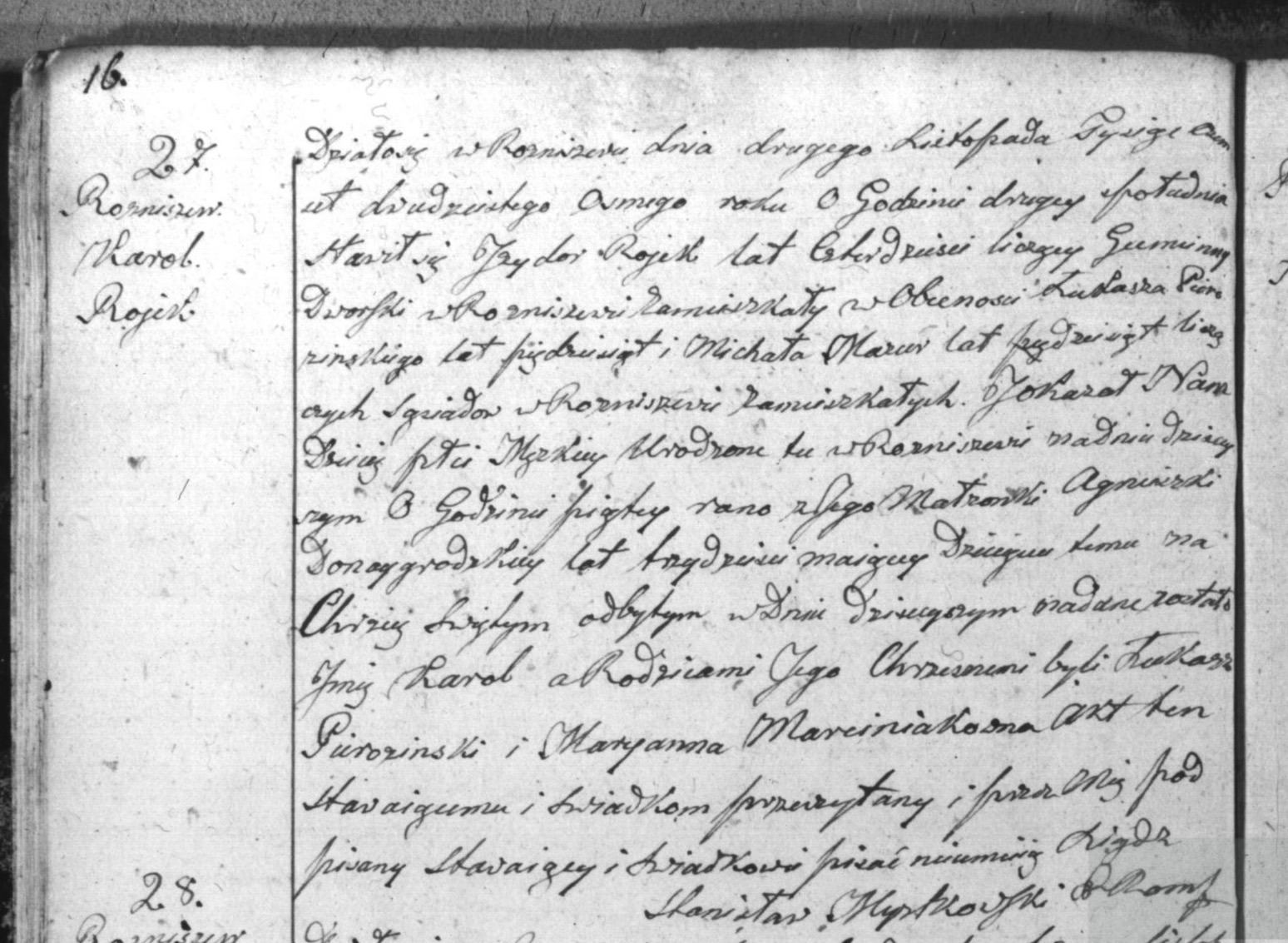 27ROZNISZEW, POLAND · 2 NOV 1828
“Dziecięciu temu na Chrzcie Świętym […] nadane zostało Imię Karol”
At holy baptism, the child was given the name Karol.
Historical family research. This record does not establish any modern applicant’s citizenship eligibility.
Read the full record cardSources & review date
Research method checked against the sample report and Polish State Archives guidance on 22 October 2026. Record survival, access and archive holdings vary by place and period.
Article reviewed . Linked authorities may revise their instructions after this date.
- Polish State Archives: genealogy and where records are held
- US National Archives: naturalization records
- Polish State Archives: search catalog and digitized records
- Polish Genealogical Society: Geneteka finding aid
- Original sample scan: Rozniszew, birth act 27/1828
