Start with the citizenship chain
For an inherited-citizenship case, the central question is whether citizenship passed from parent to child through the relevant generations. A modern Polish birthplace, a Polish surname and a family story can help you locate records. None establishes that chain on its own.
Build a short timeline before a large family tree. Put each person’s birth, parents, marriage, emigration and naturalization on one line. Mark exact dates from documents separately from family estimates. This makes the next research task much clearer.
Why 1920 needs its own evidence
Many families left a partitioned territory before the modern Polish state was re-established. The 1920 Act set several rules for initial citizenship, including settlement and treaty-based provisions. “Born in Poland before 1920” is therefore not a sufficient conclusion.
For these lines, ask what evidence connects the ancestor to Polish citizenship when the relevant rule took effect. Depending on the history, useful leads include population registers, domicile records, Polish passport files and consular registration. Foreign naturalization dates may be just as important as Polish birth records.
Look for events that changed the legal position
The rules operating before 19 January 1951 differ from those that followed. Foreign naturalization, foreign military or public service, marriage and the way citizenship passed through parents can all need review. The 1951 and 1962 laws introduce further questions.
Do not treat an exception as an automatic rescue. The pre-1951 military-service-liability exception, for example, requires evidence and legal interpretation. A researcher can establish dates and locate military records; deciding the legal effect requires the complete facts.
- Record the event date, not only the document issue date.
- Check whether the next child was already born.
- Keep unknown answers visible instead of guessing.
Use two research tracks
The Polish track connects people to places and to each other. Parish and civil registers can name parents, maiden names and spouses. Citizenship-related records may then establish a status that a birth entry does not.
The overseas track follows the emigrant after arrival. In a US case, a petition, oath or certificate may settle a date that changes the entire research priority. Census entries can suggest where to look, but a census notation and a naturalization decision are different kinds of evidence.
Know what you are paying for
Our $79 Polish Pre-check organizes the documents you already have into risks and missing evidence. The $890 Evidence File covers one line up to four generations, with scan references, checked readings, link explanations and a certified-copy shopping list. The pre-check fee is credited toward that file.
These are research services. Legal representation, government decisions, certified copies, apostilles and sworn translations are separate unless a written scope specifically includes them. A useful result may be a well-supported reason to stop spending on a weak line.
Your first small step
Choose one ancestor and gather three things: the earliest reliable birth record, the record linking that person to the next generation, and the best evidence of foreign naturalization or its absence. Save the source with each item.
Then use the loss-trap checker to identify questions worth investigating. Its result is a research signal, not a citizenship certificate. An unresolved date should lead to a specific record request, not a confident yes or no.
One family link, clearly bounded
Karol Rojek’s 1828 birth act names Izydor and Agnieszka Donaygrodzka as his parents. His 1852 marriage names the same parents, despite a surname variant. Together they support a relationship. They do not show whether a later descendant acquired Polish citizenship in 1920, kept it, or passed it to a present-day applicant.
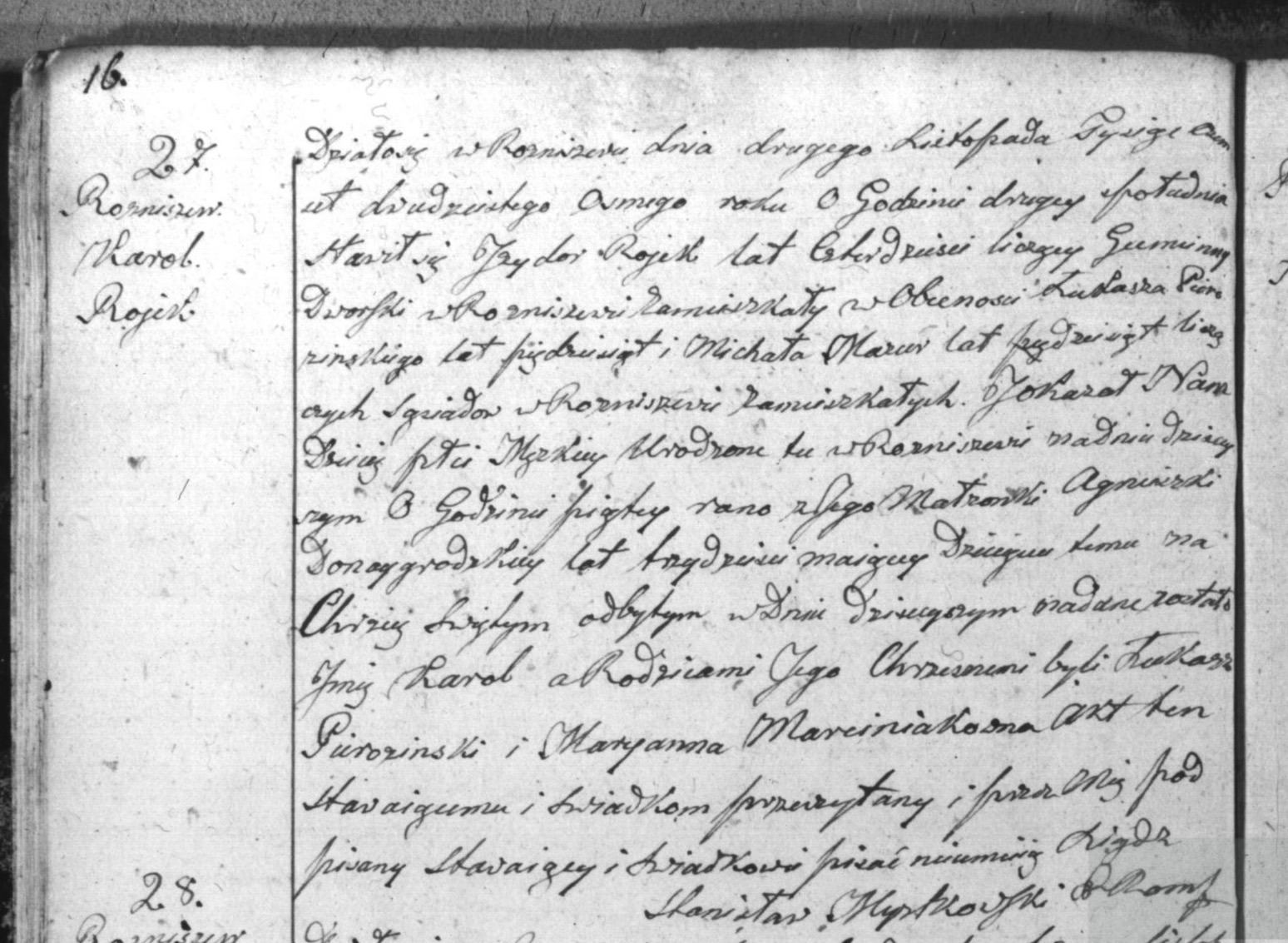 27ROZNISZEW, POLAND · 2 NOV 1828
“Dziecięciu temu na Chrzcie Świętym […] nadane zostało Imię Karol”
At holy baptism, the child was given the name Karol.
Historical family research. This record does not establish any modern applicant’s citizenship eligibility.
Read the full record cardSources & review date
Research guidance reviewed 22 October 2026. The linked laws and official instructions take priority. A historical record establishes the facts it contains; a citizenship authority or qualified legal adviser applies the law to the complete case.
Article reviewed . Linked authorities may revise their instructions after this date.
- Official text: Polish Citizenship Act of 1920
- Official text: Polish Citizenship Act of 1951
- Official text: Polish Citizenship Act of 1962
- Polish Ministry: confirmation procedure, domestic fees and timing
- US National Archives: naturalization records
- Original sample scan: Rozniszew, birth act 27/1828
