Ordinary descent follows a parent-child chain
For ordinary descent, ask whether the parent held German citizenship when the child was born and whether the law then in force transmitted it in those circumstances. The answer depends on dates, legal parentage and historical rules, not simply the number of generations.
Work one birth at a time. A great-grandparent can matter because they may have passed citizenship to a grandparent, then a parent, then you. Do not skip the middle generations because a distant ancestor’s German certificate looks persuasive.
§5 addresses specified discriminatory rules
Section 5 StAG creates a declaration route for specified people affected by earlier sex-discriminatory citizenship rules and their descendants. The underlying qualifying children must have been born after the Basic Law came into force. The provision also includes exclusions and other conditions.
The declaration window runs to 19 August 2031 under the 2021 commencement and ten-year period. A German mother somewhere in a family tree is not enough: identify the person affected, the relevant birth and marriage circumstances, and the chain connecting that person to you.
Restitution is a separate inquiry
Article 116(2) of the Basic Law concerns people deprived of German citizenship by the Nazi regime on political, racial or religious grounds and their descendants. Section 15 covers additional citizenship disadvantages connected with Nazi persecution.
These routes should not be collapsed into ordinary descent. Relevant research may include residence registration, deprivation lists, emigration, restitution files and records showing the circumstances of persecution. The BVA explains the distinction between deprivation and other persecution-related loss or exclusion.
Early emigration is a warning to investigate
The German mission’s historical guidance describes loss through long residence abroad before 1914, including a ten-year rule with relevant interruptions or exceptions. This is especially important for ancestors who left before 1904.
Do not infer survival from a German birthplace or loss from a departure year alone. Look for passports, consular registration, return journeys and the family’s naturalization history. These records may be harder to locate than a parish birth, so test the issue early.
A modern map cannot choose the archive for you
A record created in a former German jurisdiction may now be in Poland or another country. Start with the place name used at the event date, its civil registration district, the family’s denomination and the years needed.
The document type also matters. A Standesamt civil entry, a church baptism and a municipal registration card are different sources. German handwriting can require specialist reading, but a readable transcription still needs a justified identity match. Similar names are a search lead, not a completed link.
Build a useful first bundle
Gather the emigrant’s birth evidence, marriage record, naturalization record and the next generation’s birth. Add any German passport, citizenship certificate or residence registration you already hold. Preserve annotations and reverse sides; small details can change what the document establishes.
Use Passport Finder to organize the line for research. Our strongest archive coverage is Poland and Central Europe; a German case outside that coverage may need another specialist. A legal reviewer or the competent authority must determine which route applies.
A transferable method, not a German claim
Our Polish sample links Karol’s 1828 birth and 1852 marriage using the same parents despite different surname forms. The same discipline is useful when comparing German civil and church entries. This sample is not evidence of a German ancestor, a §5 case or a restitution claim; it demonstrates how a relationship is documented.
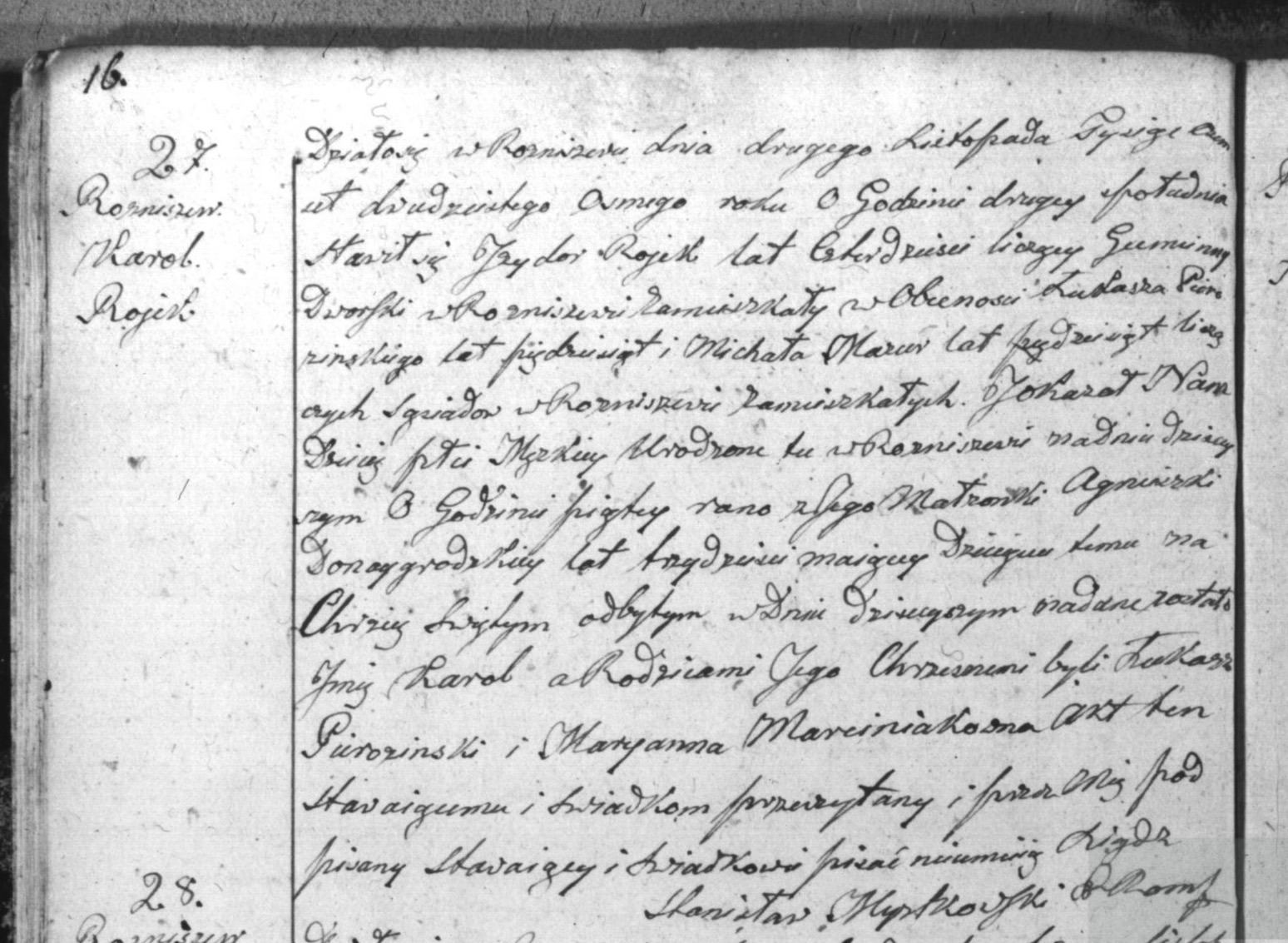 27ROZNISZEW, POLAND · 2 NOV 1828
“Dziecięciu temu na Chrzcie Świętym […] nadane zostało Imię Karol”
At holy baptism, the child was given the name Karol.
Historical family research. This record does not establish any modern applicant’s citizenship eligibility.
Read the full record cardSources & review date
Research guidance reviewed 22 October 2026. The linked laws and official instructions take priority. A historical record establishes the facts it contains; a citizenship authority or qualified legal adviser applies the law to the complete case.
Article reviewed . Linked authorities may revise their instructions after this date.
- German mission: citizenship acquisition and the generation chain
- Official German text: §5 StAG, citizenship by declaration
- Official German text: §15 StAG, restitution
- German mission: historical loss, including residence abroad before 1914
- BVA: the difference between Article 116(2) and §15
- Federal Foreign Office: nationality law and 2021 declaration reform
- Original sample scan: Rozniszew, birth act 27/1828
